What I Learned in 2022
I was incredibly inspired by the "52 things I learned in" section on Tom Whitwell's blog, and at the end of last year I decided to write something similar, but only from the world of the Internet. Now, of course, I realize that limiting myself to Internet facts was quite rash. I promise to fix this next year. Here's what I managed to gather in 2022.
Scientific research is underway on using a smartphone's accelerometer for recording speech from speakers.
Google, Facebook, and Amazon lead the digital market, accounting for more than 65% of total advertising spending and providing up to 90% of the industry's annual growth in 2016. Pierre de Poulpiquet
During Soviet times, the CIA reconstructed the electrification scheme of the Urals and nuclear industry facilities from a photograph in the magazine "Ogonyok." vakhnenko
Hydra accounted for 75% of all darknet revenue in 2020 — at least €1.23 billion. The platform entered the top 10 venues by cryptocurrency turnover, surpassing exchanges Kraken, OKX, and Poloniex. 2
Meta, TikTok, and others collect data from website web forms — including email addresses and passwords — via integrated trackers used for marketing purposes, before the user who filled them in clicks "Submit." 3dnews
Content providers such as Microsoft, Google, Facebook, and Amazon currently own or lease more than half of undersea cable bandwidth. nytimes
According to a sales report based on data from companies responsible for LTO tape production, 148 exabytes of total tape capacity were shipped in 2021. The industry hasn't seen such growth in 15 years. And IBM with Fujifilm, as an experiment, even created a tape drive with a capacity of 580 TB — a record among all storage media. Most new tape cartridges already have a lower price per gigabyte than HDDs. And the rate of recording density per square centimeter isn't declining, remaining at around 33% per year. Hard drives currently only achieve 10-15% annual density increase. habr
At some Russian bank, the waiting time for tech support when calling the hotline depends on the number of social media subscribers. Source: Artur Khachuyan
68% of all kernel changes were made by the 20 most active companies. For example, during the development of kernel 5.13, 10% of all changes were prepared by Intel, 6.5% by Huawei, 5.9% by Red Hat, 5.7% by Linaro, 4.9% by Google, 4.8% by AMD, 3.1% by NVIDIA, 2.8% by Facebook, 2.3% by SUSE, 2.1% by IBM, 1.9% by Oracle, 1.5% by ARM, 1.4% by Canonical. 13.2% of changes were prepared by independent participants or developers who didn't explicitly state they worked for specific companies. 1.3% of changes were prepared by students, postgraduates, and representatives of educational institutions. By the number of lines of code added to kernel 5.13, the leader was AMD, whose share was 20.2% (the amdgpu driver contains about 3 million lines of code, which is roughly 10% of the total kernel size — 2.4 million lines come from auto-generated header files with GPU register data). opennet
Linux holds about 2% of the total desktop and laptop market; in numbers, according to Gartner's estimates at the beginning of 2021, there were 1 billion 318 million PC and laptop users worldwide, and 2% is approximately 26.5 million users (whether Chrome OS users are included is unknown). We can also try to look at Steam service statistics — here Linux users make up 0.86%, which from a peak online of 24 million is about 206 thousand, and from 90 million monthly active users, 774 thousand. Perhaps a more honest number lies somewhere between 1 and 12 million users. Source. These numbers are also confirmed by the Steam platform. linux.org.ru
- Russia has the sixth largest internet exchange point in the world — MSK-IX, covering seven million-plus cities. xakep.ru
A few facts about Google and their data centers:
- According to Internet Live Stats for 2017, Google's data centers process an average of 40 million search queries per second, which amounts to about 3.5 billion queries per day and 1.2 trillion per year. The search engine indexes about 20 billion web pages every day. Gmail stores email for more than 500 million users worldwide, with an average of 17,000 emails per mailbox.
- Google uses its own Google File System (GFS), designed for storing large volumes of data. GFS parallelizes operations across multiple machines simultaneously, encrypting and storing information in at least 3 locations at once.
- Since 2018, cooling systems in Google's data centers have been fully managed by artificial intelligence. The system managed to reduce energy consumption by 40%.
- Google employees use IRC channels for communication.
According to data from analytical firm Canalys, in Q2 2022, worldwide laptop sales saw an almost 19% decline.
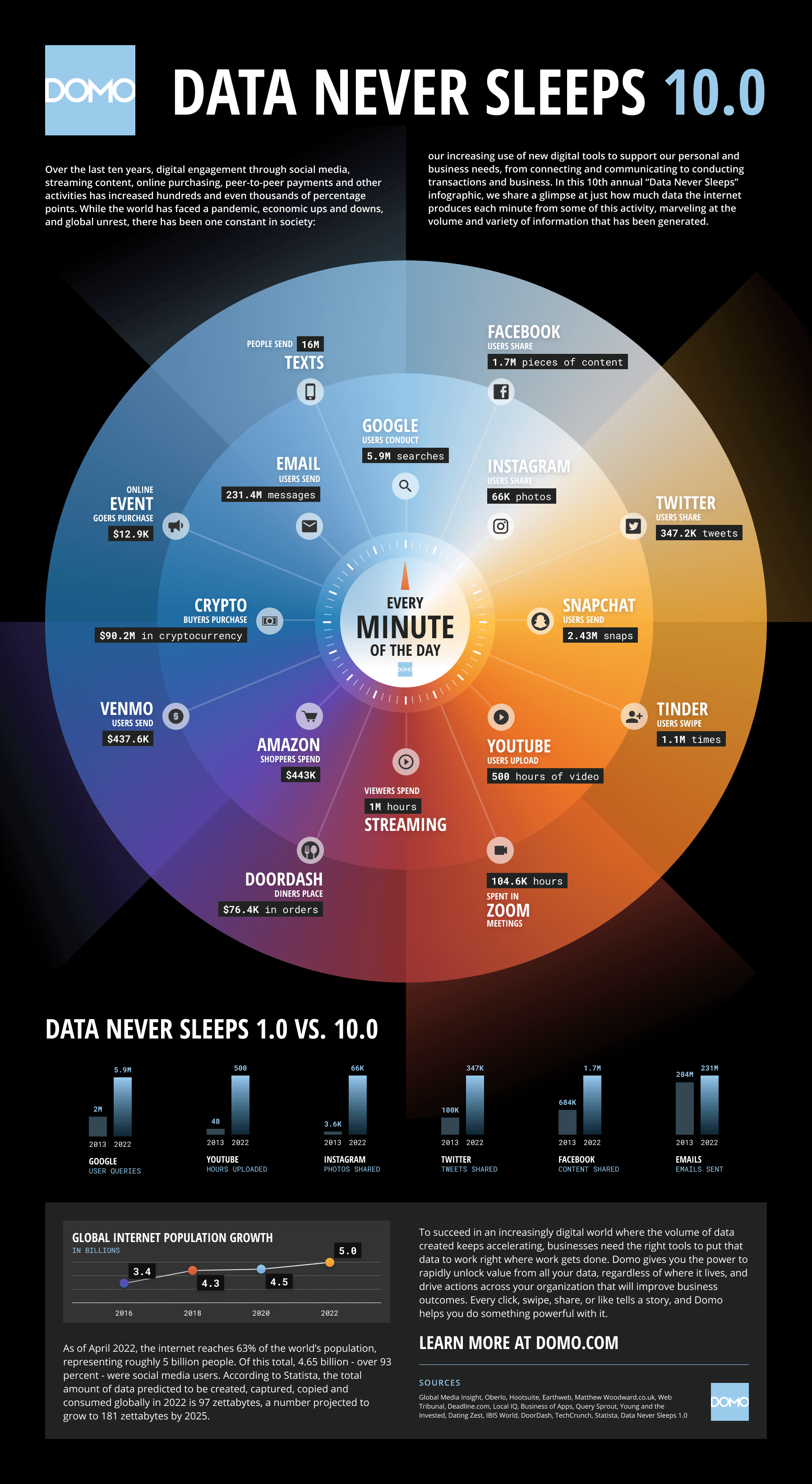
According to Domo's research in the Data Never Sleeps 10.0 report, in one minute on the internet:
- 231.4 million emails were sent
- 500k hours of video were uploaded to YouTube (compared to previous years, views are declining annually)
- 1.1 million Tinder profiles were rated per minute
- 1 million hours of video content were watched on streaming platforms
- 66k photos were posted on Instagram
- 104.6k hours of video calls accumulated on ZOOM
- Internet users sent 16 million text messages
More details
Apple Music's streaming audio library includes 100 million tracks. Users have subscribed 860 million times to the company's services, including Apple Music, Apple TV+, Apple News, iCloud, and other platforms. habr
According to a BeyondTrust report, in 2021 the National Vulnerability Database (NVD) of NIST recorded a record number of publicly disclosed vulnerabilities — 18,439, i.e., an average of more than 50 per day. Despite stereotypes, only 1,212 vulnerabilities relate to Microsoft products, which is even 5% less than the previous year. However, the majority of these were in IE and Edge, which jumped by 280%. theregister