Books I've Read in 2019
In this article, I will tell you about the books I read in 2019. I read many of the books solely because of positive recommendations on smart-lab or habr. Some books I sought out intentionally. In general, I hope my reviews will inspire someone else to read these books as well.
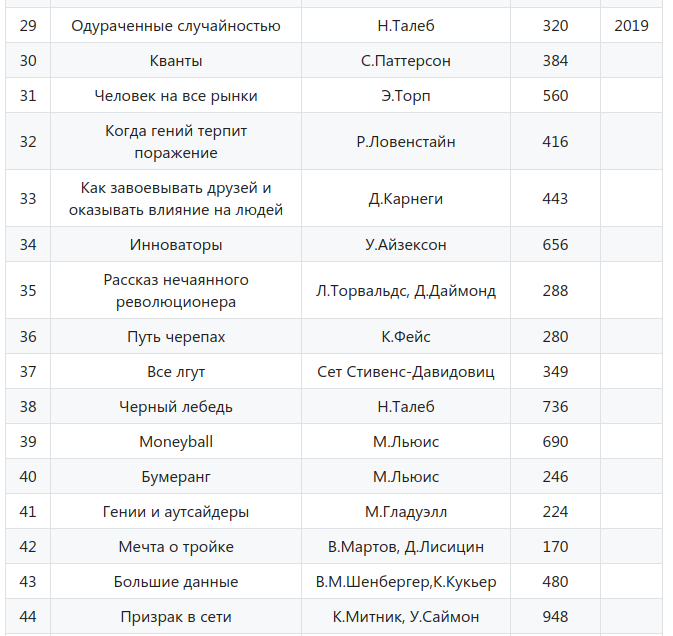
I don't like the review genre for evaluating books; I much prefer theses, short overviews, or interesting facts from the books. In 2015, I set a goal to read at least 20 books a year, and only this year did I manage to get close to that mark. Below are reviews of the most memorable books.
Fooled by Randomness
The role of randomness in our lives is very significant — we must remember this. The danger lies in the fact that people are unable to account for randomness in their forecasting models. Moreover, people often see patterns in random data sets. There are methods to combat such biases, but they are applied only in highly specialized fields.
A Man for All Markets
The memoirs of the American mathematician Edward Thorp, who organized one of the first algorithmic funds and invented the card counting method in Blackjack. In collaboration with mathematician Claude Shannon, he also developed the world's first wearable computer. The book reveals an interesting fact — Thorp was actually the first to derive the formula for pricing derivatives, but decided not to publish it in academic circles. Thorp used the formula for trading warrants and was quite successful at it. But all the fame went to Fischer Black and Myron Scholes, who received the Nobel Prize in Economics for creating the model.
The Quants
The book describes the process of establishing algorithmic hedge funds on Wall Street. But, as in any story, the most important role is given to people. The financial sector was one of the first to realize how important investing in personnel is. Funds hired the best scientists, programmers, and engineers; they were the first to open their doors to geeks. All to gain an advantage in the financial market.
When Genius Failed
The book tells the story of the Long Term Capital Management (LTCM) fund. The fund had an outstanding composition — scientists, Nobel laureates, "star" portfolio managers. LTCM had a technical and intellectual advantage over everyone else and enjoyed endless trust in financial and political circles. The fund used quantitative models for arbitrage trading with high leverage. LTCM's fortunes worsened after the Asian crisis and the Russian default in 1998. The lack of liquidity played a cruel trick on the fund. The authorities were forced to organize a $3.6 billion financial injection to prevent widespread panic. In 2000, the fund was dissolved. But the former team learned from past mistakes and created a new fund that operated successfully until 2008.
The Innovators
It describes in detail different periods of the digital revolution. The story begins with the modification of a weaving loom into a computing device by Charles Babbage and continues to the present day. The key idea of the book is that the rapid development of IT would have been impossible without collaboration between different specialists. Engineers developing hardware collaborated with physicists; programmers shared their developments with mathematicians. The greatest contribution came from the military, who funded the creation of computing devices for calculating projectile trajectories. For the spread of the personal computer, we should thank the hippie movement, who believed that the PC should work for the benefit of society. Interesting fact: Steve Jobs was not the first developer of the graphical user interface — the idea was borrowed from the Xerox PARC research center.
Just for Fun
I assume that many who use the Linux OS would like to know more about the ideological inspiration behind the open source movement, Linus Torvalds. The book covers Linus' biography, how he started developing Linux, his philosophy on life, and his opinion on open source. Despite the fact that Linus did not aim to make money or gain fame from his OS, money and fame found him on their own — Red Hat and a number of other Linux-related companies gave him shares worth $20 million before their IPO. In his homeland, Finland, he was listed among the most outstanding Finns. I am sure the world has duly appreciated his work, as Linux has gained popularity all over the world — on web servers, at gas stations, on smartphones, and even on the ISS(!), the Linux OS is installed.
The Black Swan
The book is similar in idea to the previous book by N. Taleb, "Fooled by Randomness." But here I encountered a difficulty — the book is incredibly hard to read. Reading this book took me six months.
At one time, I was interested in speed reading methods, but I quickly abandoned them, realizing it wasn't quite right for me. I try to read books thoughtfully. Depending on the genre, different amounts of time are spent reading. Technical literature takes longer; other types take much less. For example, I read the last book of 948 pages in about ten days.
So in this book, on every page there are words that I'm sure 90 percent of readers don't know. I had to regularly use a dictionary. Additionally, the book frequently mentions philosophical movements (for example, Platonism, skepticism, Stoicism) and quotes the works of various scientists and philosophers that you need to familiarize yourself with separately to understand the meaning. Don't believe people who say they read the book in a week and loved it. Either they didn't read it, or they simply didn't grasp the true meaning of the book. For full immersion, I recommend reading it 2-3 times or stretching the reading over many months.
Moneyball
The more profitable a business, the more efficient it is. This rule long bypassed the most popular game in the US, baseball, until the talented manager of the Oakland Athletics, Billy Beane, stepped onto the scene. The game lends itself to quantitative analysis. Player prices and the very principle of the game were irrationally distorted. Players with excellent stats were undervalued due to external defects and were not popular. Beane had a personal score to settle with the scouts — they had once promised Beane, then a player, fame, but their methods of evaluating players were flawed, and Beane's career didn't pan out. Billy Beane decided to change everything and hired analyst Peter Brand, who used mathematical analysis and statistics to turn the entire game around.
Outliers
The book answers pressing questions — why do some people achieve success while others do not? The author examines this question from all possible angles, touching on cultural characteristics, time, and place. For example, why are Asians predisposed to mathematics — it's all about linguistic features. The author emphasizes how important the principle of being in the right place at the right time is. Another interesting fact: in school, the academic performance of children from families with different income levels is absolutely equal; the gap occurs during summer vacation. Children from wealthy families study more in the summer than children from low-income families, who are more left to their own devices. The book mentions Christopher Langan, a man with an IQ of 195 who gained fame after his scientific work "The Cognitive-Theoretic Model of the Universe," even though he has no higher education and worked most of his life as a bouncer at a nightclub. His story is told in the context of adaptability — about how important it is to be more adapted to life than to have a high IQ. After all, people with much lower IQs achieve greater heights solely through their ability to adapt and stick to their principles.