Reflections on the Internet
In this article, I want to share my perspective on the modern Internet and highlight some of its problems. I will try to identify the key issues without diving too deeply into details and solutions. To some extent, these reflections are utopian and unrealizable. But living life without a goal is a far worse fate.
I would also like to note that despite all my criticism, the Internet is not an absolute evil — I don't want to go to extremes. The Internet has brought many useful changes to our lives and still has its "blooming gardens."
What's Wrong with the Modern Internet
I'm sure I don't need to prove to the reader that the modern Internet, both technologically and morally, has become a tool of manipulation and surveillance — fake news, bots, toxic communication culture, companies like Cambridge Analytica, Geofeedia, NetSweeper, and others. The infrastructure that powers the Internet is entirely owned by large corporations.
Corporations offer us "convenience" at the expense of privacy. Now users regularly sign user agreements that give these companies the right to transfer personal data to other organizations, from advertisers to governments.
I miss the days when Internet users aspired to maintain a personal blog, wrote interesting articles, and shared advice and experience. It was a pleasure to read them. But now, look at any social network — it's a completely sterile space consisting of dumb memes and meaningless photos; there's no constructive communication to speak of.
The Internet has become a hostile space — you're surrounded by ads, cookie banners, trackers, analytics, phishing, and troll farms, and this is only what we can identify. Large social networks have long been manipulating feeds to hold users' attention and increase ad exposure. When the hell did all these social network users turn into pigeons pecking at smartphone screens?
An equally significant problem is that engineers — the bright minds of my generation — are no longer trying to improve people's lives; they are developing ways to push unnecessary junk on you. To some extent, this is a technological form of mind manipulation.
Although Edward Snowden managed to draw attention to the importance of privacy technologies, it is engineers who must make this technology suitable for the masses.
I liked a quote from vas3k — it well illustrates the problem of the low prevalence of privacy tools.
If you give people a technology — it will remain the domain of 0.01% of hardcore geeks like us. If you give a new, convenient way to solve problems based on that technology — it can change the world.
The problem also lies in the fact that engineers are not inclined to study the humanities, and ethical issues lie precisely within those disciplines. This problem is reflected in the Hippocratic License — an ethical license for open source projects that specifically prohibits the use of software to violate universal human rights standards.
How to Fix the Situation
Next, I will try to highlight the most obvious problems and theoretical ways to solve them that could make the global network freer and more resilient.
Internet Architecture. The Path to Decentralization.
Since the dawn of computer networks, they have functioned on the basis of open protocols and were managed by the community. The entry barrier was high — not everyone could, for example, run and configure a web server at home.
The Internet is constantly evolving, and as a response to this complexity, centralized solutions have emerged that made it easier for ordinary users to be online. Thanks to them, LiveJournal appeared, allowing anyone to easily start a blog and communicate with other authors; cloud providers are ready to rent virtual servers; and corporations create entire ecosystems. And so we've arrived at a point where centralization has become widespread in the modern network, leading to infrastructure being owned by a limited circle of people in the form of corporations and state-owned companies.
The beauty of evolution is also that it exposes problems. Centralization is not only convenience — it's also censorship, mass surveillance, and your content no longer belonging to you. And most deplorably, centralization facilitates the introduction of state regulation.
It seems corporations and governments have found that sweet spot where they can both profit and control. They have no intention of changing the balance of power on the Internet — everything suits them as is, so it's not worth hoping for them, and it would even be foolish to do so. They will never give up the privileges the Internet has provided them. On the contrary, they are ready to deliberately weaken cryptographic standards.
An insane percentage of communications pass through a tiny group of corporations. Thus, the entire Internet falls into deep dependence on them. According to Wikipedia, 25% of all North American Internet traffic comes from Google's communications alone — any outage would render half the Internet inoperable.
We cannot rely on corporations and the current network architecture for resilience, security, and privacy. The world has long been dependent on the internet — failures can have a negative impact on society, the economy, and politics.
As you can see, the Internet is subject to a number of deeply entrenched problems related to its architecture, which are currently having a negative impact on security. Users continue to suffer from spam, cyber threats, and privacy violations.
Decentralization is the answer to the shortcomings of centralized networks, and in conditions of extreme dependence on the Internet, the problem of further network evolution becomes especially relevant.
Self-hosting and Software
As I noted above, not all users can, and more importantly, do not want to set up their own server — and this is one of the key points of decentralization.
It is necessary to give ordinary users software for deploying home hosting that would be secure, convenient, and as appealing as a Google account. The problem lies between the entry barrier (UI, technical complexity of setup) and the value of the tool.
If the tool is too complex for the average user, we'll get another story like Pretty Good Privacy. At its time, that solution was a revolution in private communications, but it never gained widespread adoption due to its complexity. These mistakes are vital to learn from and prevent.
Moving to the less pleasant side of the issue, I have to admit that self-hosting won't put an end to surveillance, but it will make it much more difficult and expensive for mass application.
Beyond technical literacy, users need to be taught responsibility for their own data. Your photos, correspondence, and documents have nothing to do with someone else's server — they are part of your personal life and the lives of those around you. And you should manage this data, not corporations.
Of course, self-hosting requires experience and patience from users. You will need to spend time on it, and I believe it's worth it.
Mesh Network
I am deeply convinced that governments of different countries and corporations will never be able to agree and build a neutral Internet. We can already see backbone Internet providers disconnecting entire countries they dislike, creating imbalances in the autonomous system routing scheme and contributing to network fragmentation. And the global shortage of IPv4 addresses, along with the slow transition to the IPv6 protocol, is a stark confirmation of this negative trend.
The way out of this difficult situation is to organize a mesh network.
A mesh network is a network architecture within which all network participants are equal and act simultaneously as both client and router for other participants. The key advantage is high fault tolerance and self-organization.
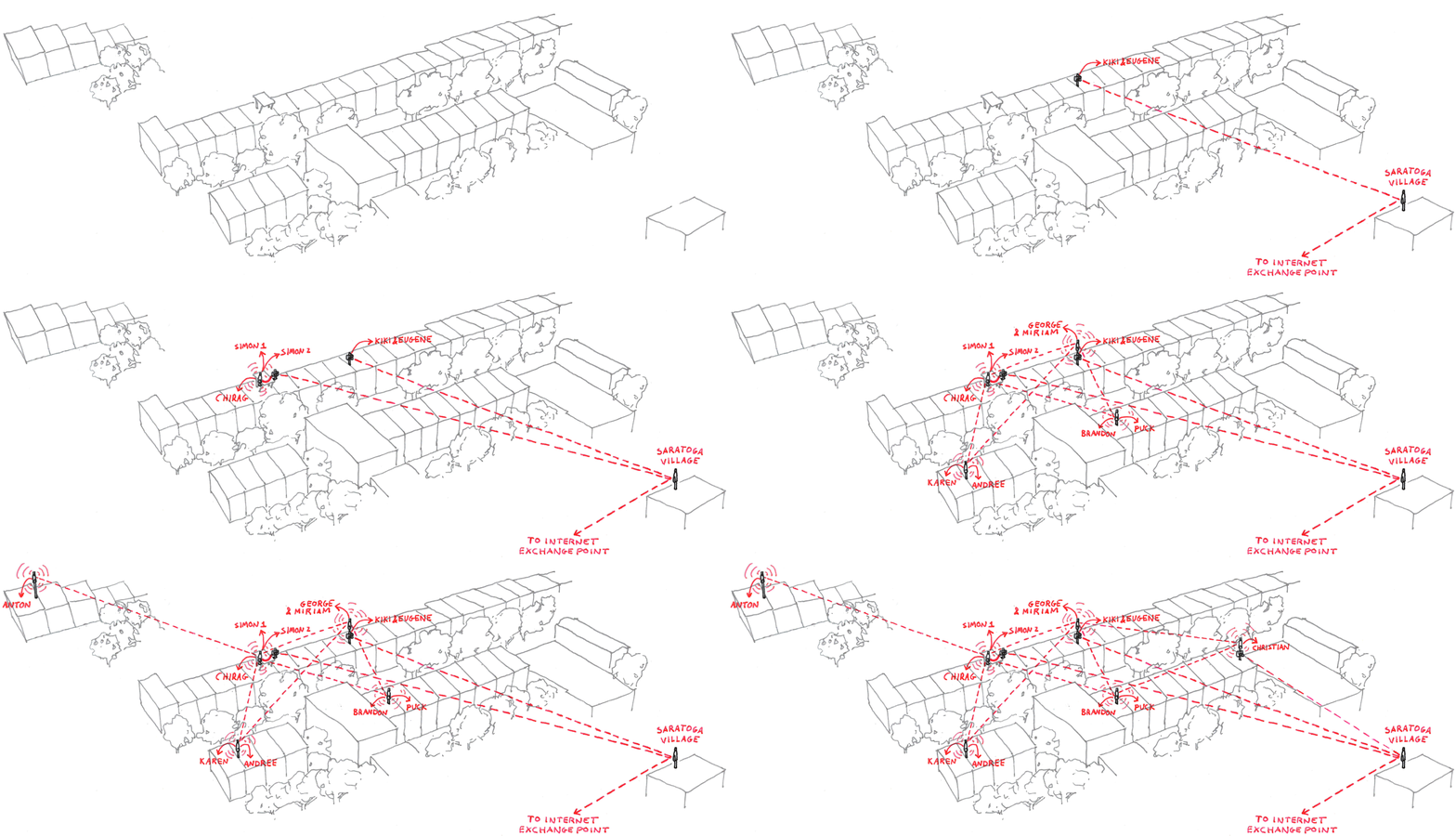 Source nycmesh.net
Organizing a mesh network would deprive corporations of control over the infrastructure responsible for the functioning of the Internet and transfer it to the public.
Among mesh networks, Yggdrasil stands out; among other things, it can operate in Overlay mode. Traffic between nodes is encrypted, but anonymity is not the network's goal.
Returning to the previous point about self-hosting, I'd like to note that HyperModem exists — software that enables quick creation of Yggdrasil nodes from consumer devices.
I find this important. Looking to a future where mesh networks become more widespread, the problem of lacking the necessary infrastructure for a global mesh network will inevitably arise. And reflashing proprietary devices is a reasonable compromise.
Some projects are already working on creating ready-made hardware solutions like Piratebox. But other projects in most cases use proprietary devices.
Among successful mesh network projects, we can mention guifi.net, AWMN, NYC Mesh, Mass Mesh, and others.
Skeptics may say that you can't trust the management of such an important attribute of modern life as a network to the community. But people — ordinary people — show incredible capacity for self-organization, a prime example being the Cuban network SNET.
Another example of mesh network application is the Briar messenger — I recommend checking it out.
The downsides of mesh networks include the need for high user engagement — it will be incredibly difficult to convince ordinary users to abandon the current Internet architecture. And network development will require hardware solutions that can be mass-produced.
The Domain Name System (DNS)
Another stumbling block in changing network architecture is DNS.
In 1983, when DNS was first invented, DNS queries and responses were sent over the Internet in plain text — and this is still the case today. Now that so much is at stake on the Internet, there is an additional need for DNS traffic encryption.
Unlike other protocols such as HTTP, DNS has long been denied security updates. One of the most important elements of the modern Internet has used the same level of encryption for the last 35 years (DoT and DoH appeared in 2018) — just think about that!
DoT and DoH protocols solved the DNS encryption problem.
But the entrenched problems haven't gone away. The way DNS works makes it practically impossible to establish an end-to-end encrypted connection from your browser to the example.com nameserver without intermediate servers knowing about it.
Add to this the fact that control over the DNS registry is entirely under ICANN's authority. Consequently, the concept of network neutrality is called into question here.
Since DNS is so critical to the functioning of the Internet, DNS security is also an extremely important part of overall Internet privacy and reliability. And handing control to a single organization, ICANN, is criminal irresponsibility!
For now, the best options are ALFIS and OpenNIC.
Finance. Problems of Cryptocurrencies
It's impossible to talk about a free, decentralized Internet without touching on the issue of finance, namely cryptocurrencies, as the technology closest in ideology.
I won't go into details, but will only comment on the inconveniences I've personally encountered.
We already have p2p exchanges that allow you to acquire crypto with a sufficient degree of privacy. But when it comes to paying for services, it turns out that internet businesses prefer to use payment gateways, and the same applies to content creators. This is bad because they consolidate data and are highly likely to share it with third parties, restrict payment methods (gateways usually only accept Bitcoin and Ethereum), and charge additional fees. And why should there be a middleman between seller and client at all — the very idea of cryptocurrencies contradicts this.
Of all the services I've encountered, only Njalla uses its own solution for paying for services with cryptocurrencies.
Media Propaganda
Propaganda is a harsh word, but I couldn't find a more suitable one. Yes, free and open source software (FOSS) needs active, organized propaganda among ordinary users. All of us have recommended to our friends and family to use FOSS in the form of Linux OS, Fediverse social networks, or the LibreOffice office suite. I think the community lacks organization in this matter — organization would allow distributing efforts across a large number of aspects.
Publicistic Writing
One of the most popular methods of FOSS propaganda right now is publicistic writing. This includes publishing articles on popular platforms, translations of articles and software itself to lower the entry barrier, and recommendations. And this is actually in good shape — the Russian-speaking community is very active in this regard.
Events, Groups, Knowledge Exchange
All of the above is unthinkable without the interaction of a huge number of people. It's hard to underestimate groups and communities with shared goals. Projects with free licenses demonstrate this perfectly.
An environment with many barriers to interaction slows down the development of both the individual and the project.
To achieve goals, communication, interaction, and coordination are necessary — streams, chats, social networks, in-person meetings, anything at all — as long as it brings together people with similar goals.
Working in a group is, first and foremost, knowledge exchange — something that goes beyond ordinary information consumption. Communicating among like-minded people fosters innovation and growth of competence for each individual group member, because without a social environment, personal development is impossible. Groups satisfy the need for communication and belonging, provide support, and most importantly — a person achieves self-realization.
Furthermore, the group allows a person to look at themselves from a different angle, at their values and interests, their social role and significance. This is a true driver for continuous personal development and the unleashing of creative potential.