Excerpts from the book "Bitva za Runet"
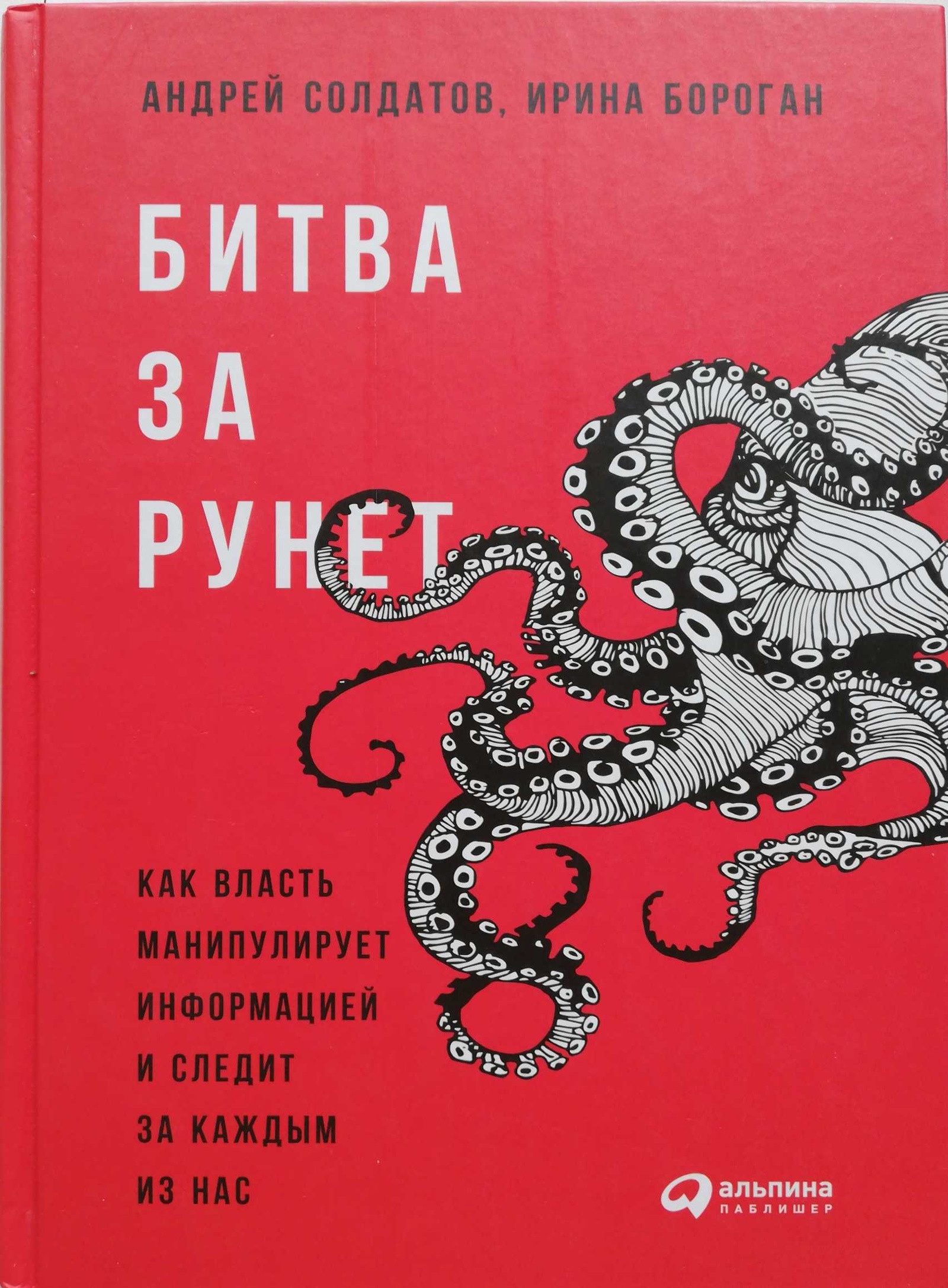
Authors: A. Soldatov, I. Borogan
According to a survey conducted by the American Pew Research Center, 73% of respondents in Russia have internet access. In China, for example, it's 63%, and in the US, 87%.
The M-9 long-distance telephone exchange houses the country's largest traffic exchange point, MSK-IX. Day after day, nearly half of all Russian internet traffic passes through it.
In a country where secrecy is a tradition, it's extremely difficult to get to the truth and get people to speak candidly.
In Marfino (Communications Research Institute, NII-2), engineers, mathematicians, and linguists were assembled. Their special project was developing encrypted telephone communications personally for Joseph Stalin.
"The newspaper is not only a collective propagandist and collective agitator, but also a collective organizer," wrote Lenin.
Programs from foreign radio stations were jammed right at the border using special devices. In 1949, Western radio was blocked by 350 shortwave jamming generators; in 1950, their number grew to 600; in 1955, to 1,000, of which 700 were installed in socialist bloc countries. All of them worked to jam the signal of 70 Western radio transmitters. By 1986, there were thirteen powerful long-range radio jamming stations in the USSR, with 81 cities having their own shorter-range stations; the total number of generators in the country had grown to 1,300. Jamming was only stopped in November 1988 by a decision of Mikhail Gorbachev.
Radios manufactured in the USSR could not pick up certain frequencies, and attempts to re-solder the circuits were considered a criminal offense. Every radio receiver had to be registered, and this continued until 1962. The authorities wanted to control everyone.
The KGB required that impressions of all typewriters be kept — in case they needed to identify the author of a printed document.
Officials from the Ministry of Communications often quoted Khrushchev: Soviet citizens didn't need telephones at home, because in the USSR, unlike the US, there was no stock exchange, so there was no need for so much information.
The USSR couldn't completely abandon international telephone communication: the Olympic Games were to be held in Moscow in 1980, and generally accepted standards had to be met. In 1979, the number of international lines was significantly increased. A special telephone exchange, M-9, was opened.
For almost its entire history, the Soviet Union was a real prison for information.
In the mid-1980s, the computer revolution was in full swing in the West, leaving the USSR far behind. The country tried to learn how to make its own microprocessors, albeit without much success, and Soviet personal computers remained poor imitations of Western models. Meanwhile, the Cold War continued.
The leadership of the Kurchatov Institute assembled a team of programmers whose main task was to adapt the Unix operating system, a copy of which had been stolen two years earlier at the University of California. Unix is completely hardware-independent, so it could be used on any institute computer, whether the "Elbrus" supercomputer created in the USSR or the ES EVM, a Soviet copy of the IBM supercomputer. Another important advantage of Unix was that it could be used to build a network. The first version of the modified Unix by Soviet programmers was demonstrated in the fall of 1984 at a seminar held within the walls of the Kurchatov Institute. The team leader was 30-year-old Valery Bardin, future recipient of the USSR Council of Ministers Prize for the "Unix-ization" of the Union. Over several years, the programmers made their own version of Unix and launched a local network on it. The operating system was called DEMOS, an acronym for "Dialog Unified Mobile Operating System." For this, in 1988, the entire team received the USSR Council of Ministers Prize — albeit secretly. When they needed a name for the network, young programmer Vadim Antonov ran an English word generator. It generated Relcom. Antonov proposed decoding it as "reliable communications," and the name stuck.
The USSR's first connection to the internet occurred on August 28, 1990, when programmers from Ovchinnikovskaya Embankment (where the communications operator Demos office was located) exchanged emails with colleagues from the University of Helsinki. Finland was chosen not by chance: after the Moscow Olympics, it was the only country with which automatic telephone communication had been preserved. Soon, Relcom was granted access to the pan-European network, EUnet. On September 19, Antonov registered the domain .su on behalf of Soviet Unix users — thus a new internet segment was born.
Oracle technologies, once on the US list of prohibited export products (during the Cold War, Oracle CEO Larry Ellison said his technology would only reach Russia in ballistic missile warheads), were used by the FSB to create the Combined Data Bank of CIS intelligence services.
For over fifteen years, working for various newspapers, we wrote about the activities of Russian secret services. Andrei's first article about SORM was published in July 1998. In 2000, we launched the Agentura.Ru website, whose goal was to make the FSB and other intelligence services more transparent. We immediately set aside a separate section for materials concerning SORM.
Work on SORM began in 1994 because analog communication lines were being replaced by digital ones. But work on the project had been ongoing for 30 years, even for telephone lines.
In Russia, internet providers have no idea who is being wiretapped or why. "They [the intelligence services] don't trust the operators," says Goldstein. "You must provide a channel and the ability to remotely enter commands to connect a third subscriber [i.e., an FSB officer]."
SORM has its roots in Soviet telephone wiretapping methods. There was nothing fundamentally new about the "black box"; it was simply modified in accordance with the technological changes of the era.
The true birthplace of SORM was within the walls of the Kuchino Research Institute near Moscow. This institute was the oldest research institution of the Soviet intelligence services; its first laboratories opened there in 1929. Among KGB employees, Kuchino was considered legendary: unique technologies were invented there, such as eavesdropping on conversations in a room by reading window glass vibrations with an infrared beam.
The equipment the KGB used for wiretapping was manufactured at two factories, Kommutator and Alpha, both located in Riga, the capital of independent Latvia.
The KGB spied on its own citizens. Formally, this activity was regulated by Order No. 0050 of 1979, signed by Yuri Andropov. But the order contained only one restriction: it was strictly forbidden to wiretap party functionaries.
The 12th Department had 164 monitoring points scattered throughout Moscow. Tape recorders were running both in district KGB offices and in the central wiretapping point in Varsonofyevsky Lane, as well as at city telephone exchanges, each of which had special rooms hidden from view for KGB controllers. Telephone lines of foreign embassies were wiretapped separately. This was called "facility monitoring": each reasonably large embassy had a separate team working on it, usually located in one of the neighboring buildings.
In 1998-1999, Levenchuk did everything to draw public attention to SORM, but it turned out that none of the major providers intended to offer resistance. And Levenchuk swore off politics. He lost the battle against SORM, and lost it to the new director of the FSB. His name was Vladimir Putin. He was FSB director for only one year, from July 1998 to August 1999. One of his achievements was the implementation of SORM on the internet.
In 2008, Yandex ranked ninth in the list of the world's largest search engines.
Alec Ross, innovation advisor to US Secretary of State Hillary Clinton, spoke in London, where he declared that the internet had become the "Che Guevara of the 21st century."
Stas Kozlovsky, administrator of the Russian Wikipedia, launched an online protest. Kozlovsky conducted a survey in the Russian Wikipedia community: it turned out that 80% of users supported the protest. The Russian Wikipedia suspended operations for a whole day, and the main page displayed a banner warning that the blocking law could "lead to the establishment of extrajudicial censorship of the entire internet."
Internet companies surprisingly quickly abandoned the idea of a free internet in Russia and easily crossed the line behind which censorship was established. Having accepted the authorities' decision as a fait accompli, they preferred to focus on technical details.
By the time censorship was introduced, the largest mobile operators already had DPI equipment installed from all major manufacturers: Canada's Sandvine, Israel's Allot, America's Cisco and Procera, and China's Huawei.
Inspired, Kopelev even came up with a name for the new scientific discipline of voice recognition he had invented — phonoscopy.
NII-2, whose tasks included (and still include) the development of encryption technologies.
In 1960, Swedish researcher Gunnar Fant, working at the Massachusetts Institute of Technology, published the monograph "Acoustic Theory of Speech Production," which described a method for splitting a voice recording into samples followed by mathematical and physical analysis.
Thanks to generous KGB funding, by the early 1980s, Chuchupal's sector received its first computers — several Soviet-made machines and a couple of IBMs. The staff's task was to find applications for computers in speech recognition. This also opened new prospects for surveillance technologies.
One of the main products of the Speech Technology Center (STC) is a biometric technology capable of identifying a speaker by the physical characteristics of their voice, regardless of language, accent, or dialect. In 2010, the company implemented this technology on a country-wide scale — creating the world's first national voice identification project. The project was implemented in Mexico.
Loren Graham of the Massachusetts Institute of Technology, a leading researcher on the history of Soviet and Russian science, confirmed: "Compared to their colleagues from Western countries, Russian scientists and engineers are much less concerned with issues of ethics and morality." "I see two reasons for this," he added. "During the Soviet period, Russian scientists and engineers quickly realized that anyone who asked questions about ethics and morality would be considered 'political opposition' by the authorities and could be punished for it. So they learned to remain silent, which over time became an integral part of their profession. Of course, the USSR is long gone, but this hasn't changed." But there is a second reason. "Engineering education in Russia was focused primarily on the technical component, while issues of ethics and morality received little attention."
The Federal Service for Supervision of Communications, Information Technology and Mass Communications, or simply Roskomnadzor, was appointed responsible for internet filtering. Roskomnadzor compiles a blacklist and checks how well providers carry out censorship. This agency was headed by Alexander Zharov, a courteous and pleasant communicator but an extremely ambitious official. A doctor by training, he worked as an anesthesiologist in a regional hospital in Chelyabinsk.
In August 2005, then Prime Minister Mikhail Fradkov signed Government Resolution No. 538, according to which telecom operators must collect metadata of all their subscribers and store it for 3 years — with constant round-the-clock remote access for the FSB.
The main tool for internet governance is considered by the Russian government to be ICANN — The Internet Corporation for Assigned Names and Numbers.
The Geneva-based International Telecommunication Union (ITU), founded in 1865 in Paris to regulate telephone and telegraph communications.
Citizen Lab has become a leading source of information on how repressive regimes spy on their citizens online.
After the Boston bombings, many people became more tolerant of electronic surveillance out of fear of terrorist attacks.
At the Sakharov Center, Artyom told how he once went to check the blocked Grani.Ru. Typing in the address, he expected to see an empty page with a blocking message. But on the standard placeholder page, the local provider had written: "To bypass censorship, follow this link."
Over 15 years, Runet turned into a serious industry that accounted for 8.5% of GDP. By mid-2014, 1.3 million professionals worked in it. Russian companies dominated the local market even after the arrival of global corporations.
Russia has only about ten large traffic exchange points (compared to eighty in the US). About 60% of traffic passes through the network of one of them, MSK-IX. The heart of this network is located in the M-9 station building owned by Rostelecom. (In January 2015, Rostelecom also bought the company that owns the controlling stake in MSK-IX.)
We are confident that in many areas, Putin's point of view is still determined by his experience working in the Soviet intelligence services. Both the president himself and his fellow intelligence officers are accustomed to living in a world of threats that must be fought, and they have brought this mentality into the corridors of power.
Putin's method of control is based on tactics reminiscent of the Soviet management method: in the USSR, no one read laws to understand the boundaries of what was permitted — instead, local party bodies existed to explain what was allowed.
Putin uses the same approach of coercing the establishment of informal contacts with the authorities. To this end, legislation is formulated as broadly as possible.
The Kremlin is accustomed to dealing with hierarchical structures and organizations that can be tamed by negotiating with their leadership. But networks have no hierarchy — their nature is horizontal. Content is created not by companies controlling websites and social networks, but by users.