Excerpts from "Cypherpunks"
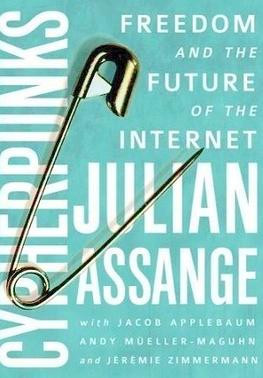
Authors: Julian Assange with Jacob Appelbaum, Andy Muller-Maguhn, and Jeremie Zimmermann
The book is written in the form of a dialogue between the authors and is well-written (if you convert audio/video interviews to text, it becomes completely unreadable). The conversation revolves around the culture of cypherpunks, the internet, and censorship.
About the Authors
Jeremie Zimmermann is a French computer engineer, co-founder of the Parisian organization La Quadrature du Net, a civil rights group defending fundamental freedoms on the Internet, and co-founder of Hacking With Care, a collective of activist hackers. Not long ago, La Quadrature du Net achieved a historic success in European politics by campaigning against the Anti-Counterfeiting Trade Agreement ACTA in the European Parliament.
Jacob Appelbaum is an American independent journalist, computer security researcher, and hacker. He worked at the University of Washington, was a key participant in the Tor Project, a system for anonymous communication. He represented WikiLeaks. He made a great contribution as a journalist to the publication of documents revealed by Edward Snowden in June 2013. Founder of Noisebridge, a hackerspace in San Francisco, member of the Berlin Chaos Computer Club, and software developer.
Andy Muller-Maguhn is a member of the German hacker association Chaos Computer Club. Having been a club member since 1986, he was appointed club press secretary in 1990, and later served on its board until 2012. In the fall 2000 elections, he was elected as a director of ICANN, the organization responsible for international domain name and IP address policy. His term lasted two years, and from June 2002 to June 2004, he served as an honorary board member of the European Digital Rights Initiative (EDRi), an organization of European NGOs campaigning for human rights in the digital age.
Excerpts
The authors expressed dissatisfaction that private companies sell network traffic monitoring and filtering tools to authoritarian regimes. Meanwhile, these technologies fall under the Wassenaar Arrangement on the transfer of "dual-use" technologies to prevent their destabilizing accumulation. However, cryptography is still considered a so-called dual-use technology, and in many countries its export as an end-user product is restricted by law, while at the international level this issue is regulated by the same Wassenaar Arrangement.
The US regularly holds cyber defense competitions for students. The US Navy sponsors a game to find potential cyber soldiers.
After Johannes Gutenberg invented the printing press, it was banned from time to time in various parts of Germany, precisely because printing was spreading: it was banned in one locality, and it moved to another jurisdiction. Printers were persecuted by the Catholic Church because they violated its monopoly on book production, and when they had legal problems, they moved to where printing was allowed. The ban, in its own way, helped spread printing presses.
People responsible for national defense started talking about technology as if they understood how it works. They often talk about cyber warfare, and none of them — absolutely none — talk about cyber peacebuilding or peacekeeping. They always talk about war — that's their business.
Why is digital intelligence so popular? It's all about cheapness. Information storage is getting cheaper every day. The Chaos Computer Club calculated that storing all telephone conversations in Germany for a year with decent sound quality would cost about 30 million euros, including administrative costs, with storage itself costing about 8 million. Similar calculations were made for the disclosed 196.4 billion minutes of landline calls in Germany for 2010, digitized with a voice codec at 8 Kbps quality, totaling 11,784 petabytes, rounded up to 15 petabytes. Given that storing one petabyte costs about $500,000, we get $7.5 million, or 6 million euros. Add the cost of decent data center equipment, computing power, connections, and payroll. Even if we include another 101 billion minutes of mobile calls in Germany for 2010, amounting to another 50 petabytes and 18.3 million euros, storing this data would cost less than one military aircraft like the Eurofighter (90 million euros) or F22 ($150 million).
The line between state and business is blurring. It's no secret that the NSA and Google are US defense partners in the cybersecurity sector.
It's complete madness to realize that we share all our personal data with IT companies, and then the secret police essentially privatizes those companies. When it comes to Facebook, we now have democratic surveillance. Instead of paying people, as the Stasi did in East Germany, we celebrate social networks as a subculture — people hook up there. And at the same time, they inform on friends: "Oh, those two got engaged"; "Wow, they broke up"; "Oh, I know who I need to call."
We used to say that a Facebook user isn't really a client. In reality, they're the product, and the real client is the advertisers. This is the least paranoid, most harmless description of what this social network does. The problem is that you can't blame a company for complying with the laws of a particular country. Following the law is normal; not following it is criminal. So you can't say, "Hey, they're following the law!" Is that an accusation?
If people are targets for you, and you live in a country whose authorities tend to look at the world through a crosshair... Admit it, placing Facebook servers in Gaddafi's Libya or Assad's Syria would have been the most appalling negligence. (Another reference to the Wassenaar Arrangement)
According to the authors, efforts should be focused on:
- Decentralization of internet architecture The biggest threat to decentralization is cloud computing. It allows data to be concentrated in one place, which in turn makes it easier to surveil users and deprives users of control over their data. The beauty of a decentralized network is that everyone stores their own information locally.
- Popularization of cryptography At present, cryptography is strong enough, but its problem is that it's difficult for ordinary users to understand. This leads to its low popularity.
- Development of open source software and open hardware solutions. Open source software is one of the foundations of a free online society — it allows you to always control the machine and prevents the machine from controlling you.
If the government encounters an encrypted message, no matter how much power it has, it cannot solve a mathematical problem.
The Blackberry phone, which has a built-in encryption system used on the Blackberry network. The Canadian firm Research In Motion, which manages this network, can decode the infotraffic of ordinary users, and it has at least two data centers — in Canada and the UK — so the Anglo-American intelligence alliance can access all Blackberry communications.
If only American citizens had come out against SOPA and PIPA, it would have been far too little. No, the whole world protested, and hackers were at the forefront, providing the means for ordinary people to participate in the public debate: On Tumblr, you could enter a phone number on the homepage, after which you'd get a call connecting you to Congress. You'd talk to someone and state your point of view: "These laws are bullshit."
It is extremely important that we, hackers with technical knowledge, guide ordinary people and tell them: "You should use technology that gives you control over your personal data, not Facebook or Google" — and that people can get along with technology, or at least can come to terms with it. That's a grain of optimism.
System architecture is the main thing we're fighting for.
The currency system — the economic infrastructure for exchanging currencies — is currently collapsing. And anyone with an eBay account will immediately agree — what Paypal, Visa, and MasterCard do essentially leaves us no choice but to accept monopolistic terms. One of the WikiLeaks cables contained an interesting fact: Russian authorities tried to negotiate with Visa and MasterCard so that payments by Russian citizens would be processed on Russian territory, and Visa and MasterCard refused to work under those conditions. Link to the material.
"Anonymity Bibliography" and "Anonymity Article Collection," curated by Roger Dingledine and Nick Mathewson: http://freehaven.net/anonbib
David Chaum is an American computer scientist and cryptographer, advocate for privacy-preserving technologies, and widely known as the inventor of digital cash. His 1982 dissertation is the first known proposal for a blockchain protocol. Chaum's dissertation, complete with code for implementing the protocol, proposed all elements except the chain of blocks, which were later described in detail in the Bitcoin whitepaper.
Chaum's Ecash (an anonymous cryptographic electronic cash system in 1983) was used as a micropayment system in an American bank from 1995 to 1998 and is issued centrally, but uses cryptography to ensure transaction anonymity. Bitcoin differs from Chaum's currencies in that all transactions using it are public, but the currency itself is controlled by no one.
E-gold — a now-defunct digital currency, as well as the name of the company founded in 1996. The US Department of Justice accused the company's owners of "conspiracy to commit money laundering." They pleaded guilty and were sentenced to seven years of house arrest and community service. Material from Wired on this topic. The sentencing judge stated that such a lenient punishment was justified because the creators of e-gold had no intention of engaging in illegal activities. (Incidentally, carders around the world used this payment system.)
The authors, in discussing propaganda, mentioned the fact that Western propaganda is not as straightforward but more sophisticated.
In the West, censorship is far more sophisticated and multi-layered — it deliberately confuses people and leads them away from understanding what is really happening. Such complexity is needed to deny the existence of censorship altogether.
For example, the Guardian, in an article about Bulgarian organized crime, referred to a certain Russian, portraying him almost as the main anti-hero, even though the message mentioned many other organizations and people besides him. And there are many such manipulations. It's unclear why this is done — whether the story about the Russian is more popular in the Western press, or whether it's a deliberate campaign.
The government says censorship needs to be introduced on the internet to fight crime, and they'll be allowed to do anything. There is an internal working document of the European Commission on data retention, and it says: "We should talk more about cybercrime, then the public will agree with us."
Christiania — a self-proclaimed autonomous territory in Copenhagen, the capital of Denmark. It is essentially former army barracks that were taken over in the 1970s by a motley community of collectivists and anarchists. Christiania achieved a unique legal status for Denmark. Wikipedia article
In the dialogue, the authors agreed that government censorship in any form and for any purpose is wrong. Instead of preventing and combating criminal activity, politicians simply censor it online. As if it doesn't exist — this is definitely not the way out. Under the pretext of protecting users, anything can be blocked. The authors argue that censorship tools should be installed and configured by the end user on their own device. And the government needs to fight crime more effectively instead of censoring things.
COINTELPRO — a secret, often illegal program of the Federal Bureau of Investigation (FBI) to suppress the activities of a number of US political and public organizations. Wikipedia
By the time of the collapse of East Germany (GDR) in 1989, it is estimated that the secret police employed 91,000 full-time staff and 300,000 informants. Approximately one in fifty East Germans collaborated with the Stasi, possibly the highest penetration of a security apparatus into any society. As a result of this collaboration, the Stasi created a huge archive containing files on more than six million people. In the last days of the GDR regime, the Stasi desperately tried to destroy the archive before it was seized by opponents. An interesting article about the Stasi.
Is it right to publish secret documents (whether corporate or government) whose disclosure could affect people in an unfavorable way? One of the interlocutors claims it is right. Because publishing such data will open people's eyes and make them think about whether surveillance, promoted under the guise of fighting crime, is really so good. And here's an example story:
After the fall of the Eastern Bloc, FRG Chancellor Helmut Kohl decided to unify Germany, and during the 2+4 negotiations, the Americans set their conditions. They said they wanted to continue controlling German telecommunications and monitoring them, and Kohl thought it wasn't important — he didn't understand what telecommunications surveillance was. People on his team were very upset about this, and eventually, they printed out about 8,000 pages of transcripts of his phone conversations recorded by the Stasi and brought them to Kohl's office on two small carts. And he said, "What the hell is this?" And they replied, "Your phone conversations over the last ten years with various people, including your girlfriends, your wife, your secretary, etc." That's when Helmut Kohl understood what telecommunications interception was.
While you're investigating Mafia crimes, information should remain secret. There are circumstances where secrecy may seem justified. However, tactical surveillance has the advantage that it can be partially regulated to harm the fewest number of people. When tactical surveillance is used for law enforcement purposes (as opposed to intelligence), it is often needed to gather evidence. Evidence is eventually presented in court, which means the information is made public. Not always, but there is some oversight over such surveillance. Those who carry it out are called as witnesses, and they can be questioned about how exactly they collected the information and why we should believe it. This process is controlled. But the regulation of strategic information interception is absolutely absurd. It is by definition surveillance of everyone, and what law can we talk about if we are intercepting all available information from the very beginning?
The government realizes that today, acting in secrecy will only work for a certain amount of time, that sooner or later the truth will come out — and it's very good that they are aware of this. Government methods are changing. They understand that their actions will one day be evaluated. Supporting this is the Sarbanes-Oxley Act, which requires companies registered on US exchanges to create infrastructures for whistleblowers, so that people who want to report crimes by their superiors have the opportunity to do so without being persecuted by those they reported.
The network amplifies alternatives and accumulates them.
"Be the glitch you want to see in the world" — a quote from the photographic webcomic "A Softer World."